

Portable Toilet Rental Costs: What to Expect in 2025
November 17, 2025
How to Find a Licensed Septic Repair Contractor in Your Area (Without Getting Ripped Off)
March 16, 2026Every construction manager knows the drill: hard hats, safety harnesses, fire extinguishers. But there’s one compliance requirement that catches contractors off-guard more than any other—portable toilet ratios. Get the math wrong, and you’re looking at fines that start at $16,550 per violation. Get it right, and your crew stays productive, healthy, and focused on the job.
The question isn’t whether you need construction porta potty rental—federal law makes that crystal clear. The question is: how many units does your specific site require, and what formula keeps you on the right side of OSHA inspectors?
The OSHA Table You Can’t Ignore
OSHA Standard 1926.51(c)(1) lays out the exact worker-to-unit ratio for construction sites. This isn’t a suggestion or best practice recommendation—it’s federal law backed by the Occupational Safety and Health Administration’s enforcement authority.
Here’s the breakdown according to Table D-1:
- 20 or fewer employees: Minimum of 1 toilet facility
- 21-200 employees: 1 toilet seat and 1 urinal per 40 workers
- 200+ employees: 1 toilet seat and 1 urinal per 50 workers
Notice the progression. As your workforce grows, the ratio shifts. A 15-person crew needs one unit. A 60-person job requires at least two facilities (one toilet seat, one urinal or two full units). Scale up to 250 workers, and you’re looking at five toilet seats and five urinals minimum.
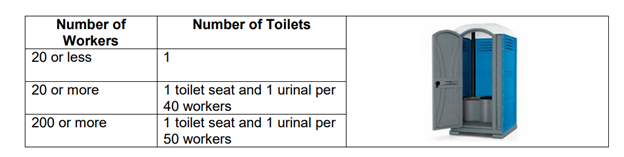
But here’s where contractors make their first mistake: they count average daily workers instead of peak shift numbers. OSHA bases requirements on the maximum number of employees on site at any one time. If your electricians, framers, and concrete crew all show up the same Tuesday morning, that peak headcount determines your minimum units—not your typical Monday staffing.
What “Readily Available” Actually Means
OSHA requires that toilets be “readily available.” That’s not vague regulatory language—it has specific interpretation. According to OSHA’s own guidance letters, workers should be able to reach a toilet facility in under 10 minutes from their work area.
Think about what that means on a sprawling site. A worker on the third floor of a high-rise who needs to descend three flights of stairs, walk 200 feet to the fence line, and wait in line has already blown past that 10-minute window. That’s not just inconvenient—it’s non-compliant.
The American National Standards Institute (ANSI) takes it further, recommending facilities be within 200 feet of work zones. While OSHA doesn’t mandate a specific distance, using ANSI’s 200-foot guideline gives you a defensible standard if your practices are questioned.
Distance isn’t the only factor. “Readily available” also means:
- No locked gates blocking access
- No requirement to sign out or request permission
- No waiting in lines long enough to cause delays
- Facilities that are actually functional and sanitary
If your porta potties are so far from the work area that employees routinely leave the site to find a gas station bathroom, you’ve failed the “readily available” test. If units are so filthy that workers avoid them, OSHA explicitly states those don’t count toward your minimum requirement.
The Sanitation Rule Nobody Talks About
Here’s where many contractors get blindsided: OSHA doesn’t count unsanitary toilets toward your minimum requirement. In a 2006 interpretation letter, OSHA stated clearly that toilets in unsanitary condition aren’t considered “provided” under the standard.
What makes a toilet unsanitary? OSHA references the ANSI Z4.3 standard, which recommends:
- One weekly cleaning for toilets serving up to 10 workers
- Twice-weekly service for 20 workers using one toilet
- More frequent cleaning for heavily used units
Translation: if you’ve got one porta potty serving 20 workers, and it only gets serviced every two weeks, you’re potentially non-compliant on two fronts—the unit likely doesn’t meet sanitary standards, and you may not have enough facilities.
Regular servicing means:
- Pumping and removing waste
- Cleaning and disinfecting all surfaces
- Restocking toilet paper and hand sanitizer
- Deodorizing the interior
- Checking for damage or needed repairs
Most construction porta potty rental companies offer weekly service as standard. High-traffic sites should negotiate twice-weekly or even more frequent service to stay ahead of compliance issues.
The ADA Complication
If you have workers with disabilities on your crew, you’re required to provide at least one ADA-compliant porta potty. These aren’t optional “nice to have” features—they’re federal requirements under the Americans with Disabilities Act.
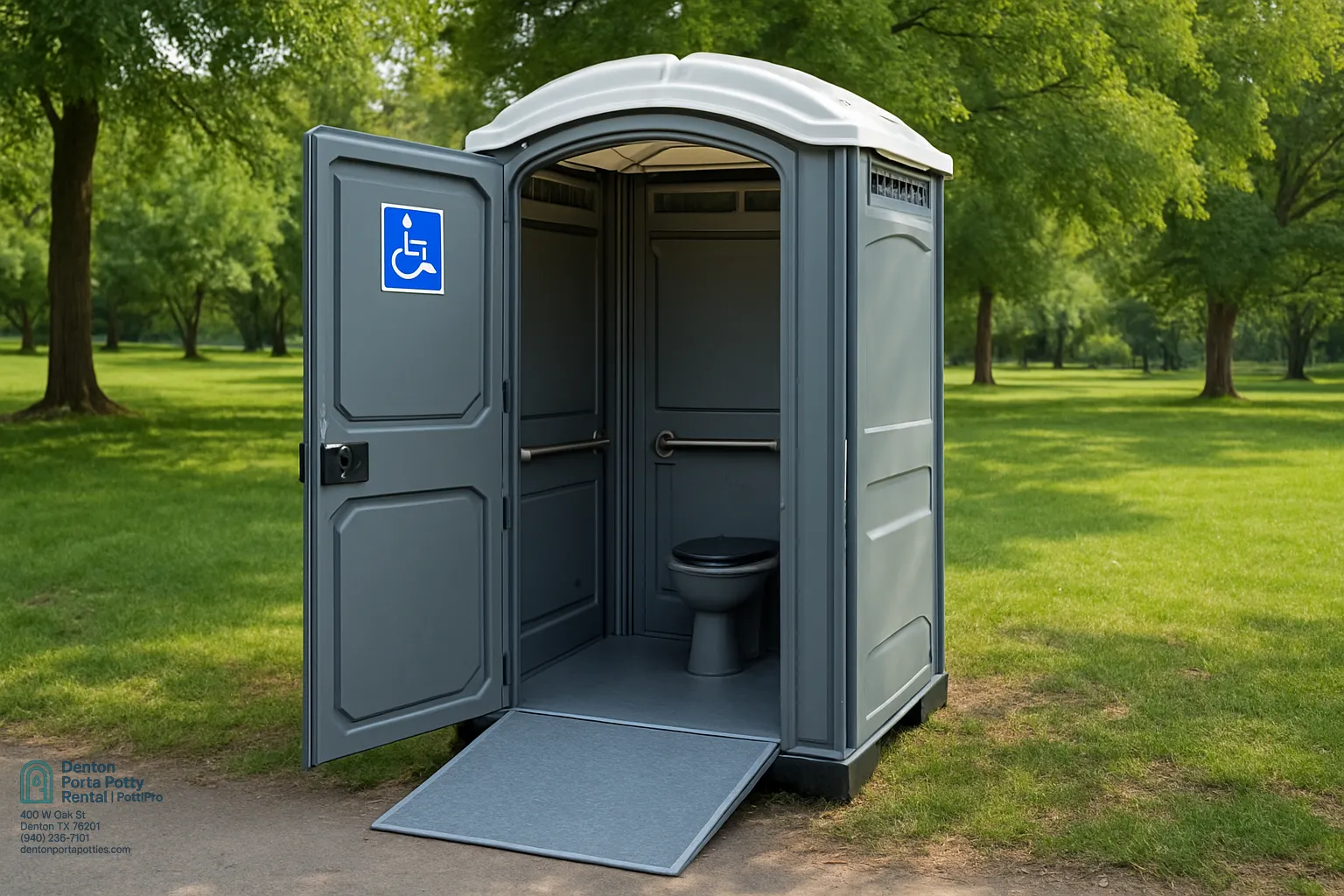
ADA-compliant units differ significantly from standard porta potties:
- Minimum 60-inch by 60-inch interior space for wheelchair turning
- Door opening of at least 32 inches wide
- Ground-level or ramped entry (no steps)
- Grab bars positioned at specific heights
- Lower toilet seat height (17-19 inches)
- Accessible hand sanitizer and toilet paper placement
For construction sites, there’s a specific exemption: portable toilets used exclusively by construction personnel aren’t subject to the 5% ADA requirement that applies to public events. However, if you employ even one worker with mobility challenges, you must provide appropriate facilities.
The cost difference between standard and ADA units runs about $25-50 more per month. The cost of an ADA discrimination lawsuit? Exponentially higher, not to mention the reputational damage and potential loss of future contracts.
Handwashing: The Forgotten Requirement
OSHA doesn’t just mandate toilets—it requires hand-cleaning facilities near or inside portable toilets. This gets overlooked constantly, but it’s right there in standard 1926.51(f).
Your options:
- Porta potties with integrated hand sanitizer dispensers
- Separate handwashing stations with soap and water
- Portable sinks mounted near toilet facilities
If you provide only water and soap, you must also provide single-use towels or air dryers. If hot and cold running water isn’t available—which it rarely is on construction sites—hand sanitizer must be mounted in or near each toilet facility.
Workers exposed to toxic materials, chemicals, or hazardous substances need more than hand sanitizer. OSHA requires access to soap and water for these situations. If your crew handles treated lumber, solvents, or other hazardous materials, plan for standalone handwashing stations, not just sanitizer dispensers.
Placement Mistakes That Trigger Violations
Even if you have the right number of units, poor placement creates compliance headaches. OSHA doesn’t specify exact placement rules, but their enforcement history reveals what triggers citations:
Too far from work areas: Units placed at the far edge of the property to “keep them out of the way” force workers to take 15-minute bathroom breaks. That violates the “readily available” standard.
Blocking emergency access: Porta potties positioned where they obstruct fire lanes or emergency vehicle access create life safety violations that stack additional penalties on top of sanitation issues.
Unstable ground: Units on soft, muddy, or sloped ground that tip or sink fail the safe accessibility requirement. Service vehicles can’t reach them, and workers risk injury using unstable facilities.
No lighting for night work: If your crew works evening or night shifts, facilities must have adequate lighting for safe access. This doesn’t mean lighting inside each unit—it means pathways and approaches need illumination.
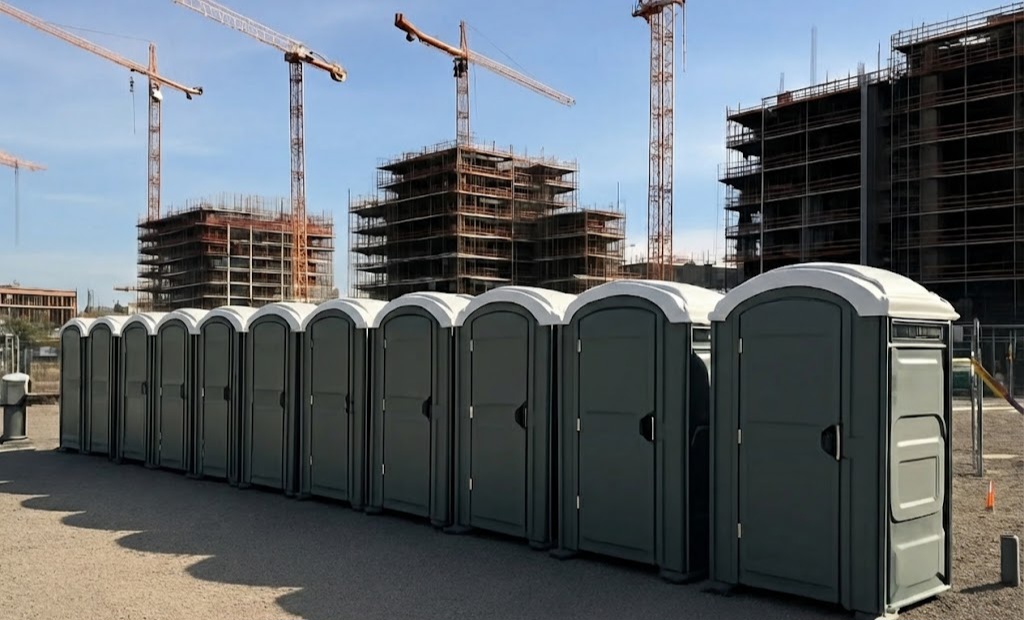
Smart placement considers:
- Within 200 feet of primary work zones
- On level, stable ground that won’t become muddy
- At least 10-15 feet from high-traffic areas and heavy equipment
- Accessible to service vehicles without blocking work areas
- Behind barriers if adjacent to public roads
- Near but not directly beside material storage or eating areas
For multi-story projects, the 10-minute rule means you need facilities on upper floors as work progresses. Hoistable or crane-compatible units solve this problem for high-rise construction, though they add cost.
The Real Cost of Getting It Wrong
OSHA violation penalties were adjusted in 2025, and the numbers should get your attention:
- Serious violation: Up to $16,550 per occurrence
- Willful violation: Up to $165,514 per violation
- Failure to abate: $16,550 per day until corrected
- Repeat violation: Up to $165,514
“Per violation” is the killer phrase. If you’re running 50 workers with only one porta potty, you’re not just one unit short—you’re in violation of the standard itself. If that unit is unsanitary, that’s a second violation. No handwashing station? Third violation. The fines compound fast.
Beyond direct penalties, non-compliance creates:
- Work stoppages during OSHA investigations
- Project delays while violations are corrected
- Reputational damage with general contractors and clients
- Difficulty bonding future projects
- Increased insurance premiums
- Worker complaints and potential lawsuits
Compare those costs to construction porta potty rental pricing: $125-275 per standard unit per month, including weekly service. For most construction sites, full compliance costs less than one day of project delays.
How to Calculate Your Exact Requirements
Let’s walk through real scenarios to nail down the math:
Scenario 1 – Small Residential Project:
- Peak crew: 12 workers
- OSHA requirement: 1 toilet (20 or fewer employees)
- Recommended: 2 units for crew comfort and backup
- If disabled worker: Add 1 ADA-compliant unit
Scenario 2 – Mid-Size Commercial Build:
- Peak crew: 85 workers
- OSHA calculation: 85 ÷ 40 = 2.125, round up to 3
- OSHA requirement: 3 toilet seats and 3 urinals (or 3 complete units)
- Recommended: 4-5 units distributed across site
- If disabled worker: Include 1 ADA-compliant in the count
Scenario 3 – Large Infrastructure Project:
- Peak crew: 275 workers
- OSHA calculation: First 200 need 5 facilities (200 ÷ 40 = 5)
- Remaining 75 workers: 75 ÷ 50 = 1.5, round up to 2
- OSHA requirement: 7 toilet seats and 7 urinals minimum
- Recommended: 8-10 units with strategic placement
- If disabled workers: 1-2 ADA-compliant units depending on crew composition
Notice the pattern: always round up, never down. If your calculation gives you 4.2 units, you need 5. OSHA doesn’t accept partial compliance.
For projects with multiple shifts, calculate requirements per shift. A site running two 12-hour shifts with 40 workers each needs facilities for 40 workers, not 80—the shifts aren’t on site simultaneously. However, if shift changes overlap, count the overlap period peak.
Selecting a Porta Potty Rental Partner
Not all construction porta potty rental companies deliver the same service level. When vetting providers, ask:
How frequently do you service units? Weekly is standard; twice weekly is better for large crews. Confirm the schedule in writing.
What happens if a unit becomes unusable mid-week? Emergency service response should be same-day or next-day maximum.
Do you provide service reports? Documentation proves compliance if OSHA investigates.
Can you scale up or down as the project phases change? Foundation work might need 3 units; finish work might need 6. Flexible providers adjust without penalty.
Do you carry insurance and comply with service regulations? Fly-by-night operators create liability you don’t need.
What’s included in base pricing? Delivery, setup, weekly service, supplies, and pickup should be standard. Watch for hidden fees.
Can you provide ADA-compliant units? Not all rental companies stock them, and you may need advance notice.
The cheapest provider usually isn’t the best value. A company that misses service appointments or delivers filthy units costs more in aggravation and compliance risk than you save on the monthly rate.
Beyond Minimum Compliance: Best Practices
Smart contractors exceed OSHA minimums because the benefits outweigh the modest extra cost:
Industry standard: One toilet per 10 workers for a 40-hour week provides better service than the OSHA minimum of one per 20.
Gender-specific facilities: While OSHA doesn’t require separate facilities by gender on construction sites (lockable single-occupancy units satisfy both), some contractors provide separate banks of toilets as crews grow larger and more diverse.
Seasonal adjustments: Summer heat and workers drinking more water means more bathroom use. Adding units during hot months prevents lines and lost productivity.
Trailer upgrades: For long-term projects or sites with office personnel, restroom trailers offer a more professional experience. They cost more but pay dividends in worker satisfaction and client perception.
Placement flexibility: As work zones shift through construction phases, move units to maintain the 200-foot guideline rather than forcing workers to trek across the site.
Service upgrades: For crews working 60+ hour weeks or sites with 24-hour activity, upgrading to twice-weekly or three-times-weekly service keeps facilities sanitary and workers happy.
The Bottom Line on Compliance
The worker-to-unit ratio isn’t complicated once you understand OSHA’s Table D-1. For most construction sites, the formula is straightforward:
- 1 facility for crews up to 20
- 1 per 40 workers for sites with 21-200 employees
- 1 per 50 workers once you exceed 200
But compliance goes beyond simple math. Facilities must be readily available (under 10 minutes away), maintained in sanitary condition, accessible to workers with disabilities if needed, and equipped with handwashing or sanitizer stations.
Non-compliance costs far more than proper construction porta potty rental. A $200 monthly unit prevents a $16,550 violation. Regular service costing $50 per visit beats a “failure to abate” fine of $16,550 per day.
The companies that treat portable sanitation as just another safety requirement—not an afterthought—build better projects, maintain healthier crews, and avoid costly regulatory problems.
Planning a construction project in the White Mountains? Whether you’re managing a residential development or a commercial build, having reliable sanitation facilities protects your workers, keeps you compliant, and prevents costly violations. Atteberry Portable Toilets & Septic has been serving Show Low and the surrounding White Mountains area since 2008 with meticulously maintained portable toilets, ADA-compliant units, and flexible scheduling to match your project timeline.
Explore our portable toilet rental services to find the right solution for your job site, or call us at (928) 242-2802 for a no-obligation quote and expert guidance on meeting OSHA requirements for your specific crew size.

